Have you ever used flash cards?
They are a proven tool to help you study and retain knowledge about a subject. The digital age allows us to bring decks of these study cards anywhere from our phones. A popular tool for this is the app named Anki.

Anki is an, often free, flashcard app that goes far beyond traditional memorization tools. Its key feature is spaced repetition, a proven learning technique based on how our memory works (Mehta et al., 2023). Instead of reviewing all your flashcards equally, Anki schedules each card based on how well you know it. Cards you struggle with appear more frequently, while those you’ve mastered are shown less often. This targeted review system boosts retention and makes the most out of your study time.
How fast can you make 300 flash cards?
Flash cards take time to make. By hand, I can probably write one in about 5 seconds. So for 300 Flash cards, that might take 25 minutes of nonstop writing. Looking up the information takes time too. If each card takes at least 5 seconds of research, that amounts to 50 minutes for 300 flash cards. That is 6 cards per minute (CPM). Read on to hear how now I create over 600 cards per minute!
My Scenario
Immersive Learning
Immersive Learning has been shown to be an effective tool in learning another language (Nie et al., 2022). Think about how you learned your first language. As a child, you did not read a textbook on language. Instead, you likely had family calling you by your name or asking if you were hungry. You would hear movies on TV, or listen to songs in the car. You learned through experience.
Today, a great way to learn a new language is to immerse yourself in it. Watch videos, listen to music, write a journal or talk to native speakers as much as you can. I have started to do this by taking Japanese songs, breaking them into pieces, and translating them to English. The first song I translated for this was “Ue o Muite Arukou” by Kyu Sakamoto.
Translating Japanese
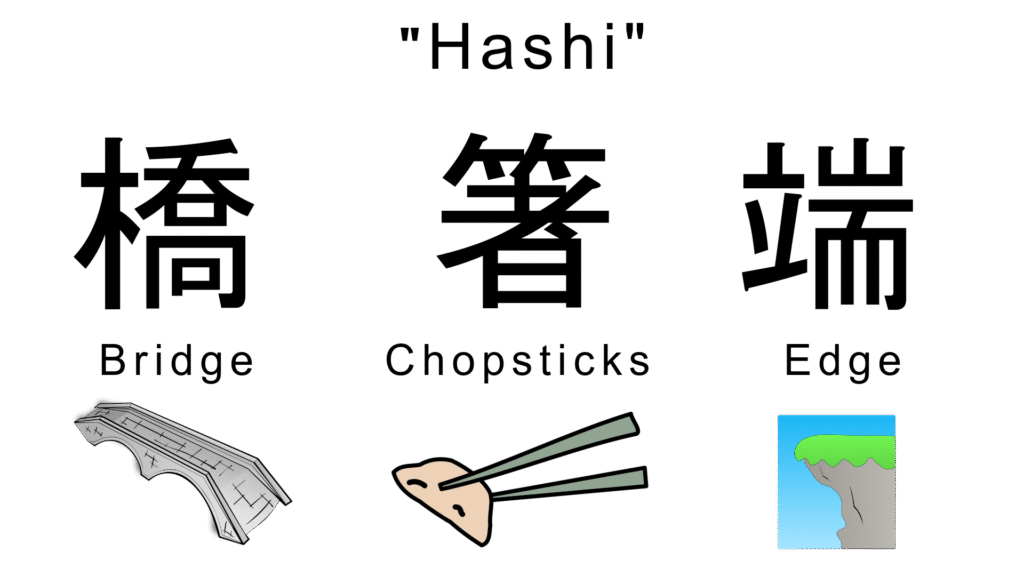
Japanese to English is one of the more difficult pairs to translate. One quality about Japanese that makes it challenging for translation is it’s reliance on context. In spoken language, the same word may have multiple sounds. Similar to how in English, many may struggle with “There, their, and they’re”. However; these occur much more commonly in Japanese. Take the word “hashi”. This one word has three meanings. Depending on the context, it could mean edge, bridge, chopsticks.
Even characters may have multiple pronunciations. See the Example Below:
上
- (jou “joe”) as in 上手 (jouzu) meaning skillfully.
- (ue “ooh-ehh”) as in 上 (ue) meaning above.
These challenges even effect popular tools like Google Translate. The below example uses the word “hashi” 4 times.
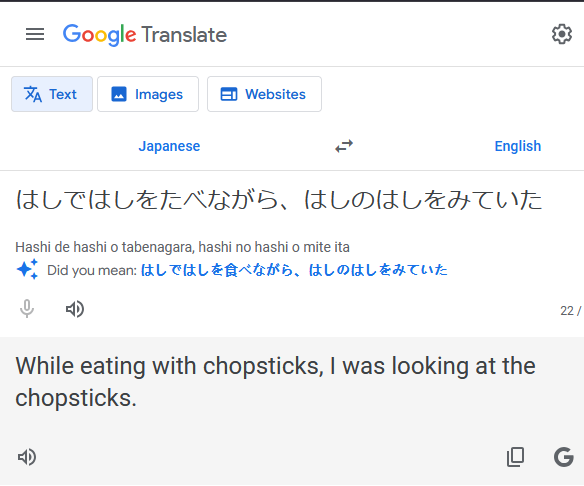
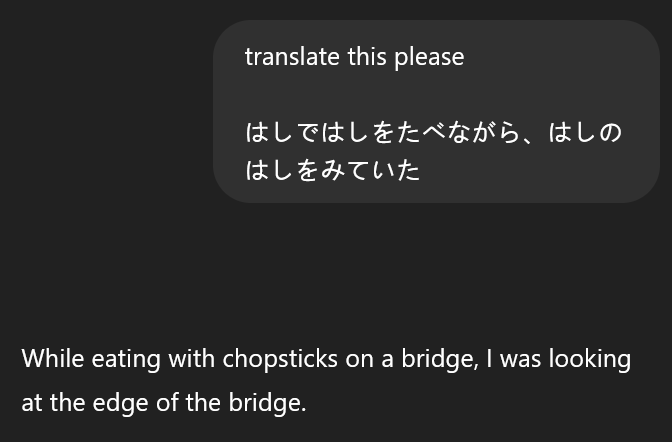
The sentence should read something like “While eating with chopsticks on the bridge, I was looking at the edge of the bridge”. “Hashi” was used 4 times in our input, Google Translate uses a translation of “hashi” twice in the output, and only 1 translation “chopsticks”.
Large Language Models (LLMs), also called AI, like ChatGPT are able to better address the context of the sentence, and provided better output even in difficult situations.
My Solution
ChatGPT Translation
To provide better translations, and save time, I decided to use ChatGPT to facilitate my translations. It’s common to use the ChatGPT website, and manually type messages to it. Alternatively, you can integrate ChatGPT directly into a program with something called an “API”. An API is like a mailbox, where two programs can send and receive messages to each other.
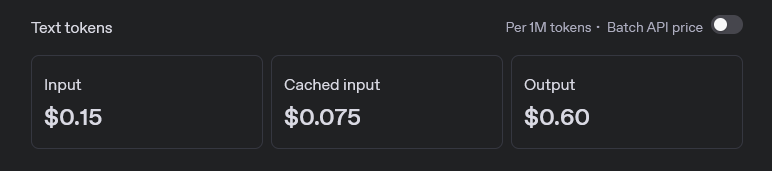
These API’s often cost money to provide the service. ChatGPT offers many versions, or “models”, of ChatGPT, each performing differently and for a different price. I tested these, and found that the 4o-mini model was both affordable, and adequate quality. When using it, you are billed per million “tokens”. Tokens can be complex to calculate, so i will use an example. I could translate the song mentioned earlier about 22 times for just 1 penny.
AI Deck Generator for Anki Tool
Developed with Python
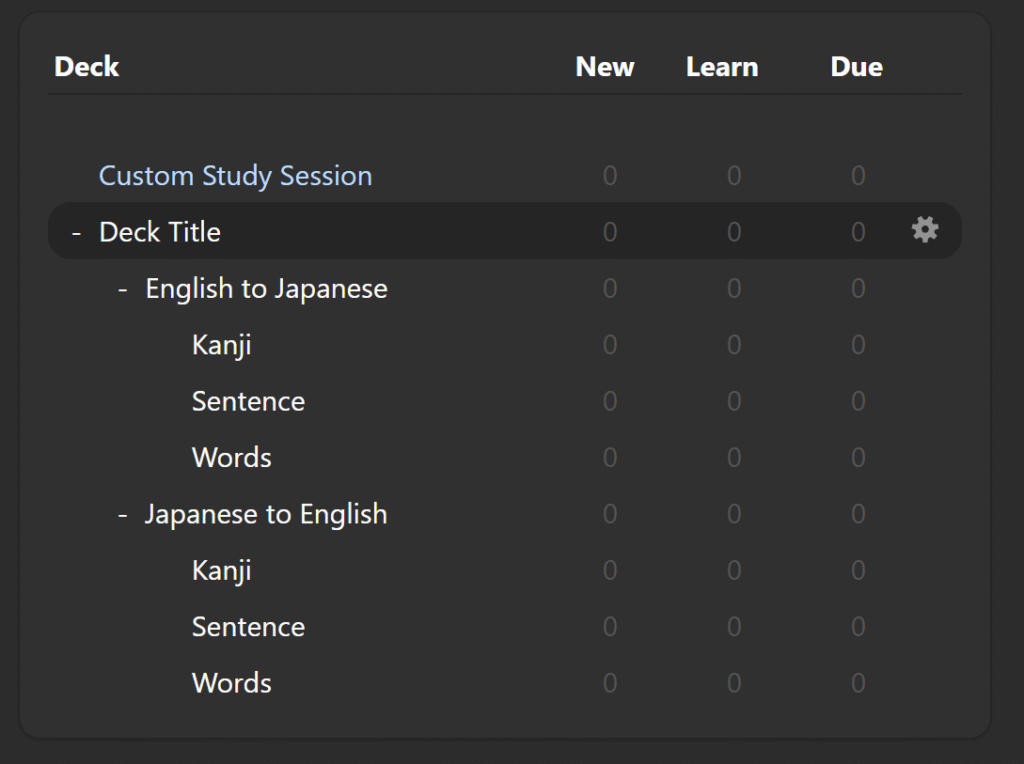
In Japanese, it’s important to understand how sentences are structured, the meanings of the words, and the meanings of the individual characters. So ideally, I would like to practice all of the above, from Japanese to English, and English to Japanese. This means building 6 decks of different cards, for just 1 song. The structure would look something like this:
We can help automate this process with a programming language called “Python”. With Python, we can take the song lyrics as input, remove any non Japanese text, message ChatGPT for a context dependent translation, and bundle the results into structured decks ready to load into Anki.
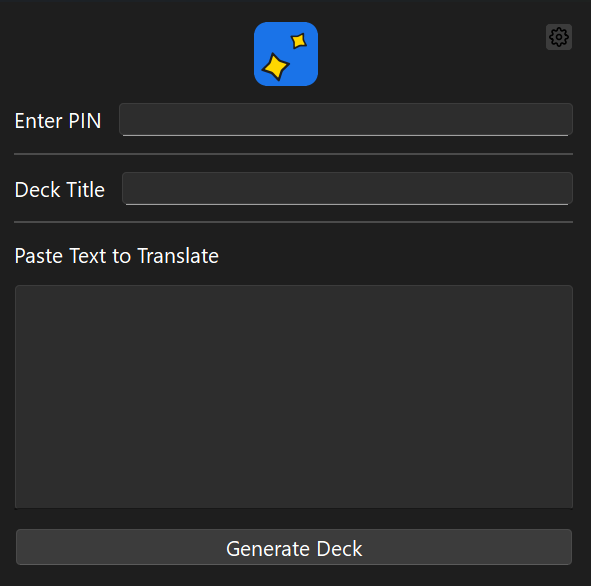
And as an added bonus, it connects to another tool, called VOICEVOX, which provides sound for each card.

How I Create 600 Flash Cards Per Minute

The AI Deck Generator for Anki tool helps me go from creating 6 cards per minute (CPM), to over 600 for less than a penny. This can turn an hour of work, into less than a minute of button clicks. This helps someone spend less time on labor, and more on learning.