
Accomplishments
- Preserving the User Experience
- Test List Documentation
- Workflow Documentation
Bonus
- Architecture Update
- Infospot Annotations
With time all things change, and so does our perspective. When developing features it is easy to become so immersed in the details and develop a sense that you’re aware of everything about the topic. With a head so buried in sand, we might forget the tide will soon come. It takes stepping away and changing topic in order to return with a fresh set of eyes to identify things that weren’t seen before. This week was a practice in that respect. I have identified and resolved many edge cases which lead to unexpected behavior within a virtual tour. These fixes don’t change the ideal user experience. Instead, they ensure that it will occur more often. To protect this experience I began collecting a list of tests to perform after changes. To better recreate these virtual experiences I have outlined the workflow and key steps required to deliver them.
Preserving the User Experience
Glitch, Bug, Error. These words have become synonymous with technology. The interesting thing about computers is that they almost always do exactly what they are told (if we don’t consider single-event upsets (Link https://en.wikipedia.org/wiki/Single-event_upset)). So really, glitches, bugs, and errors are results of misunderstood or incomplete expectations. For example, virtual tours can be viewed across desktop or mobile. When last week I added the option to right-click and drag the diorama view I had expected this to work the same on mobile. Then, to my surprise, using two fingers to drag on mobile appeared to “glitch”, only zooming in and out. Another step needed to be added which checked for two finger drag, not just right-click.
Other improvements were added. In Click and Go 3D, when viewing the diorama, you can now double click on an area in the 3D model and it will determine the closest hotspot. Previously, you had to perfectly click on the tiny circle hotspots. This had the potential to cause frustration on mobile.
The 3D cursor was hidden on mobile. It would appear where the phone was last tapped and just sit on the wall. I tested this using the tour from a tropical villa in Pattaya, Thailand. The cursor sticking to the wall reminded me of the geckos native to the resort.
Sizing is a challenge I often face when defining user interfaces. The one file is expected to cover infinite sizes and many aspect ratios. How can we ensure text is equally visible on a screen regardless of resolution? We can scale the size of the values based on the screen’s size. This way it will always display as a percentage of the screen, rather than a static pixel count. I updated the custom grid to introduce font scaling, and reduce the chance of fonts appearing difficult to see.
These along with more minor fixes and improvements were implemented and used to provide a better user experience as they navigate virtual tours.
Test List Documentation
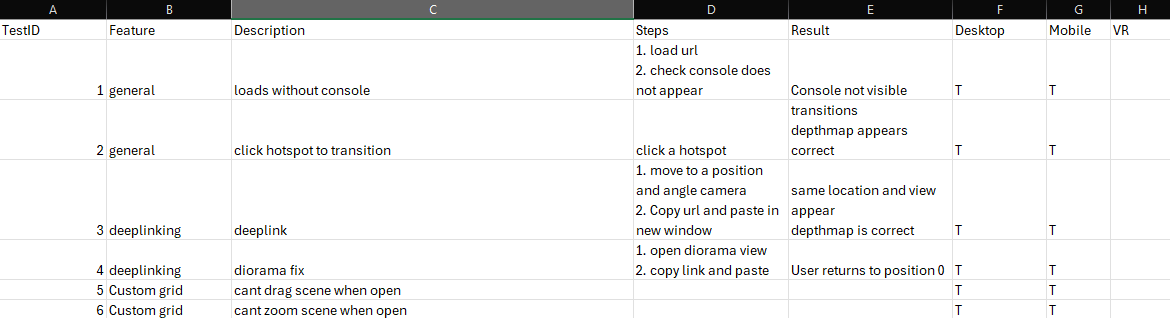
Many of us have visited a grocery store, purchased our ingredients, and only when we returned home realize we forgot something important. Lists are a great way to avoid this. I find that it’s easy to remember many things, but unlikely to remember everything always. This is why I began keeping a list of tests, or expectations, I have about the virtual tours I produce. When I change the code it’s important to return to these tests to check that I have everything the way I expect it. Sometimes one change, in one place, may affect something totally different in another place, in a way we would never expect. So as confident that I may be that my code is perfect, confidence is not fact, and lists are often more reliable.
Workflow Documentation
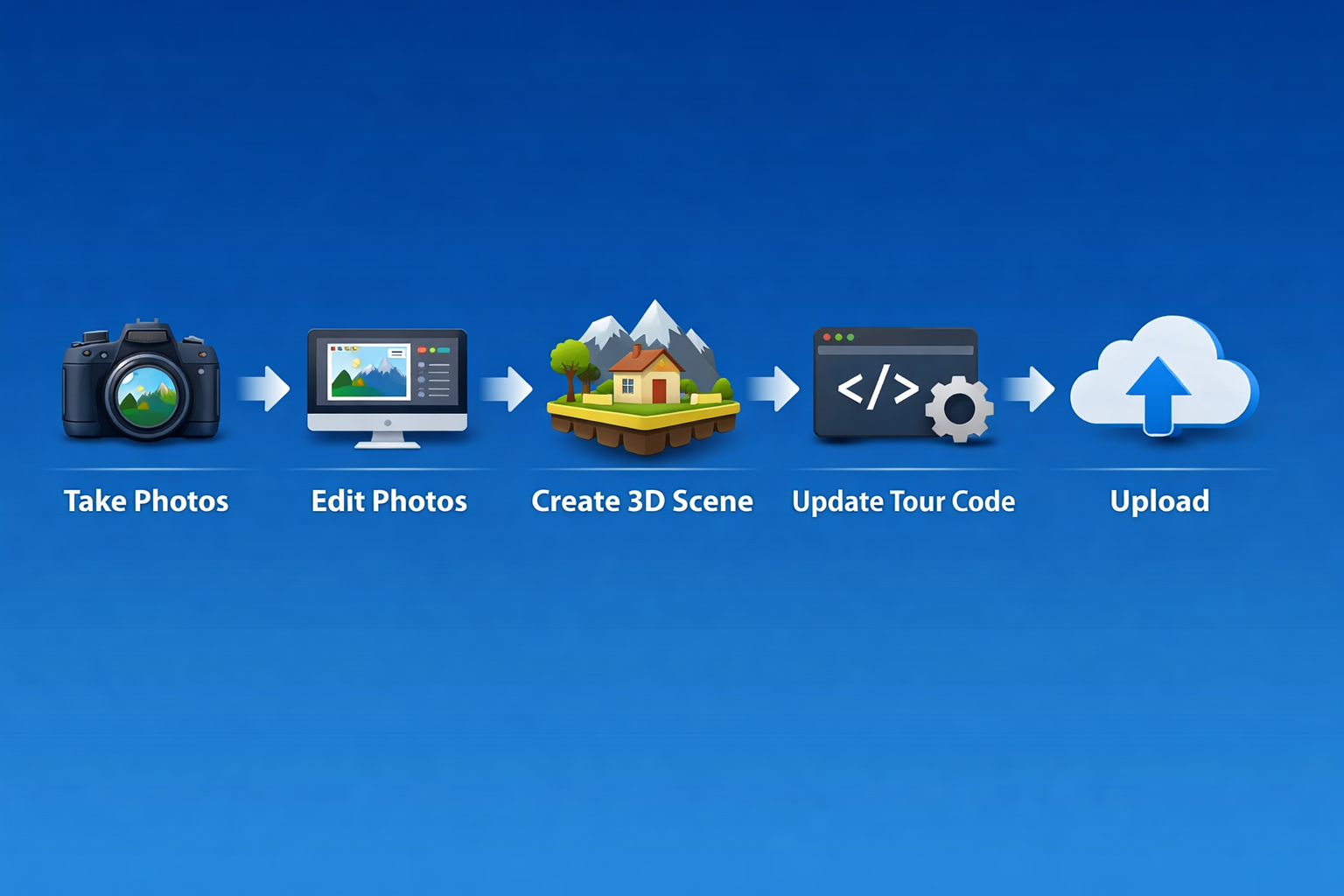
A recipe is another form of list. It’s a list of steps (sort of like a program (wink emoji)). Many of us have tried to follow a recipe from memory. Sometimes this leads to comments about how “it came out different this time”, or “did you use more sugar?”. Having a recipe ensures that something can be reproduced, and the closer we follow the recipe the more accurate the reproduction.
Virtual tours are no different. You need ingredients (text content), kitchen tools (blender, camera, custom scripts), and an order of steps (take pictures before placing them in a 3D scene). All of this leads to a result. To keep providing results at a similar quality it’s important to have a recipe. So this week I organized and expanded upon some notes I have gathered about the process and documented them. This 4 page workflow document currently covers the steps from photography to upload for a single floor 3D virtual tour. I expect this document to change with time, as more outputs are defined, different needs are identified, and different improvements are made.
Bonus: Architecture Updates
When the power goes out, standalone devices require us to go around and reset their clocks. Each one we have to reset on its own. Computers almost never have to be reset nowadays. This is because the time isn’t always from inside the computer, it is checked from some shared location, and that makes life much easier. I wanted the same to be true for my virtual tours.
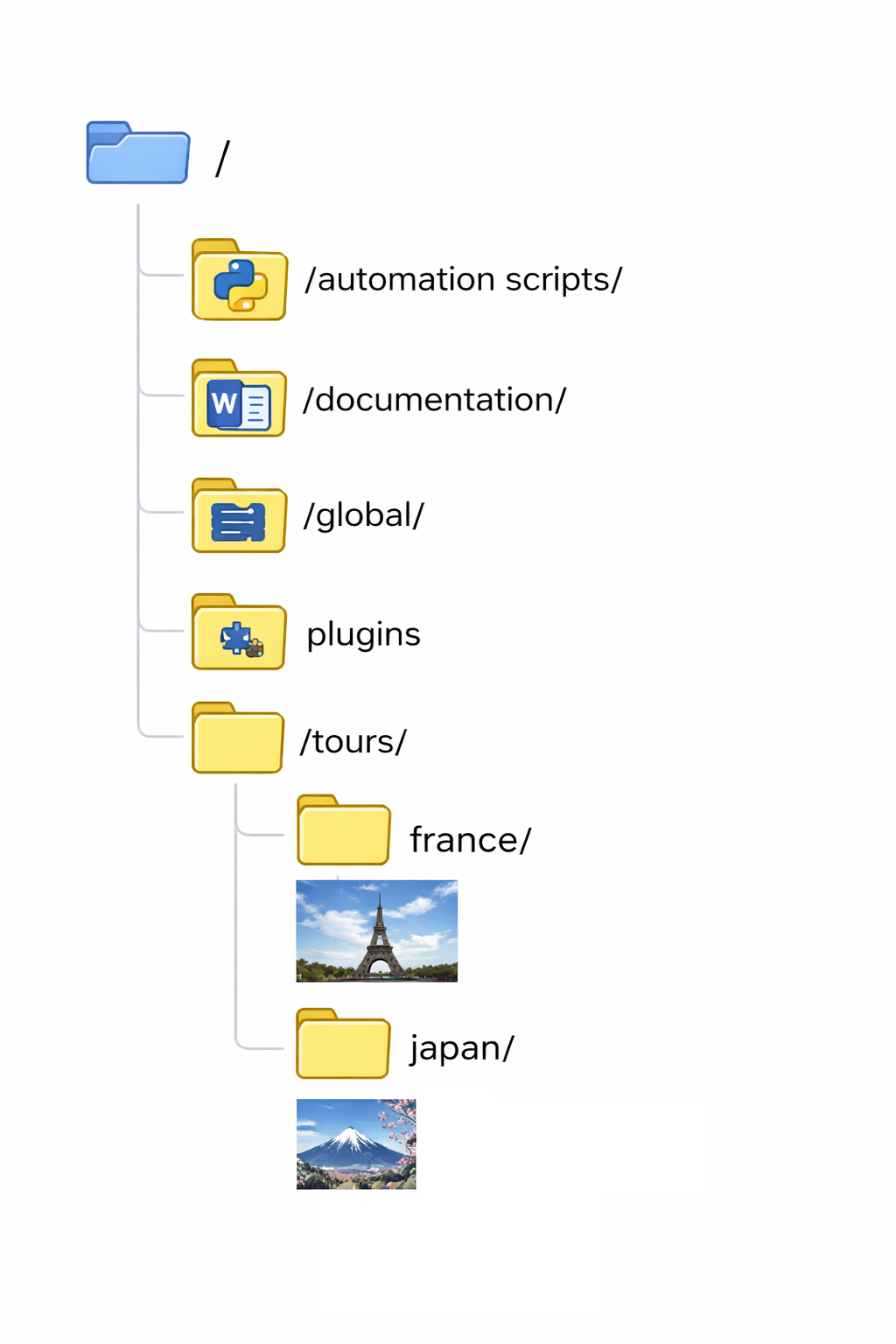
Until now, virtual tours were self contained. They lived in their own folder, with their own plugins and other files. Recently I had to update a plugin file for all of the tours on my website. It was the same file, with one instance stored locally in each of the tours. It’s annoying to update one thing in six places. It’s much better to update six things in one place! This week I was able to dedicate some time to identifying if and how this could be done on a big scale. I wanted to outline a structure that would work for any number of tours to use the same files without interrupting each other.
After a bit of research I discovered that the virtual tour software included the tools necessary to do this. With url path references like %VIEWER% and %FIRSTXML% we can reference files from the root of the project, and the root of the individual tour. From the root of the project, all tours can have access to some public or global folder. This can include shared files like UI images, plugin code, and display layouts. Within this project is a tours folder, where specific tours are saved and within them the tour specific files like the panoramas, the scenes, and settings.
With minor challenges I was able to implement this architecture in a way that allows all tours to be updated simultaneously with 1 file change. This will greatly improve efficiency, consistency, and my ability to respond.
Bonus: Infospot Annotations
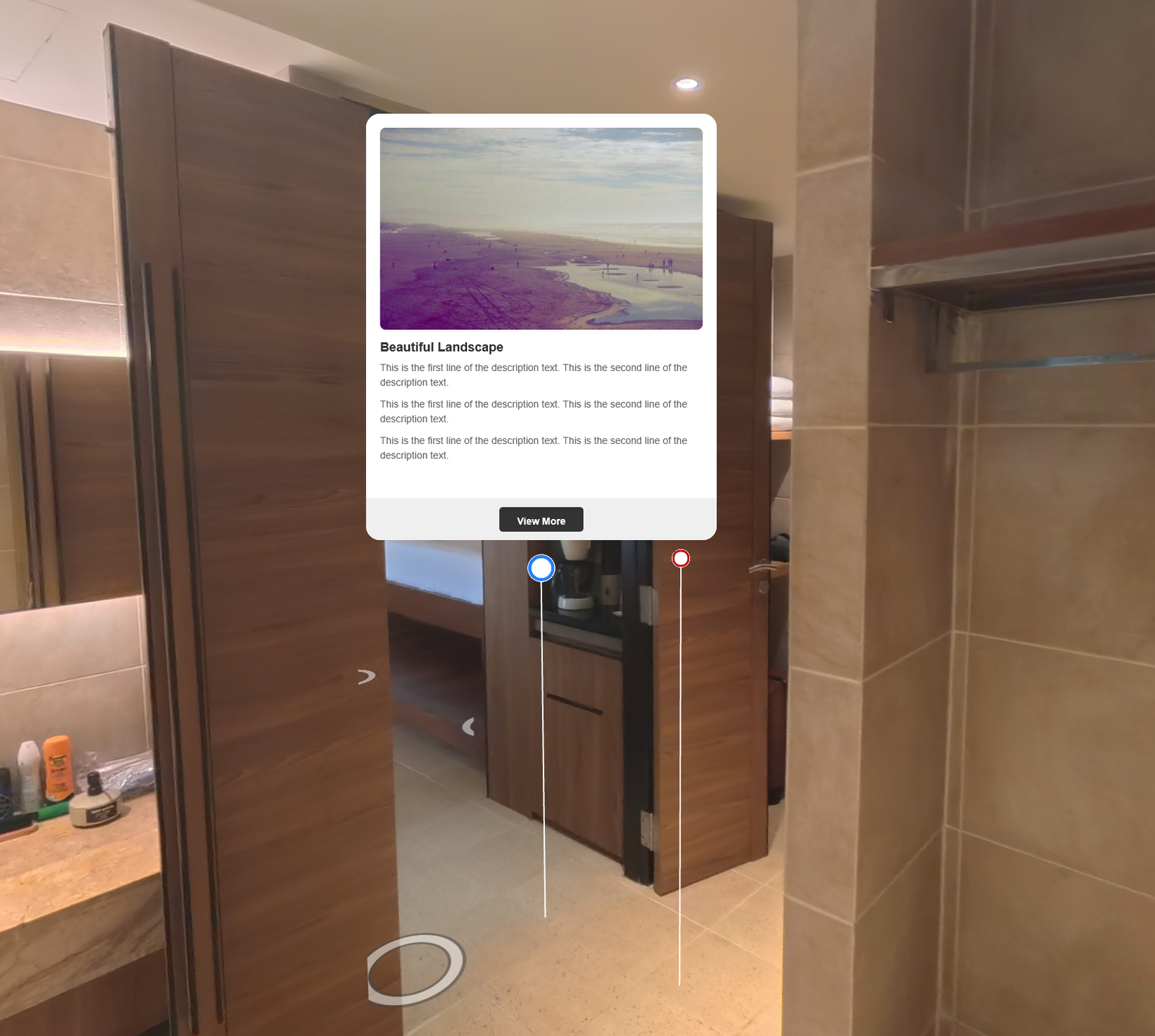
Last week I discovered a tool to assist with generating and displaying annotation hotspots in 3D scenes; however, there were some features I required which I could not confirm the availability of. This week I challenged myself to look at the problem a different way. Perhaps the tool alone isn’t the solution, but only part of it. This opened my eyes to a fruitful new opportunity.
The tool is broken up into multiple parts, an editor and the code which displays and manages annotations. The editor is used to choose where the annotations go within the scene, and it outputs these values to a file. After reviewing the values I noticed that both the annotation’s location and the floor location were available. These were two workflow challenges I faced when attempting to build this output on my own. With this data I could set the location and draw the stalk. After some attempts I was able to do this with a hotspot that always followed the camera.
My next challenge was to spawn an iframe that always stayed above the hotspot and followed it if the camera happened to move while it was open. This was very difficult to troubleshoot. For one, it requires some level of calculation. The hotspot is in a 3D space relative to the camera. And the iframe needs to be in a 2D space as an overlay on the camera. I discovered some functions available in krpano which could convert the hotspot’s 3D location to a 2D value. After some troubleshooting, I was able to get the iframe to appear consistently every time.
Quite a bit more time was spent determining how to handle the popups. Only one should be open at a time. When another opens the previous should close. When hovering over the same one it shouldn’t continue reloading the same url. A loading screen should appear during any real loading of a url. Dynamic sizing to fit the contents of the iframe. All this and more had to be reviewed, implemented, and tested in order for this feature to behave consistently.
Now, I believe I have created a tool which can take the data from the annotations editor and display it in a way that is simple and effective.
Summary
A lot of my effort this week occurred behind the scenes. Time was spent insuring things meet expectations, writing expectations, and documenting the steps to achieve those expectations. The rewards of this work are often not instant. Like flossing every day, you repeatedly expend effort just for consistency, but at your next dentist visit, or decades from now, you’re likely to end up with a much better experience. The same is true for maintenance in software. The maintenance work this week is important, and the rewards it provides will not be immediate and big, but mild and lasting.